Friday, 17 December 2021

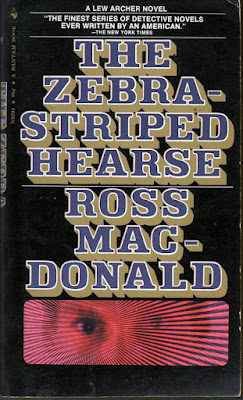
Book Review: The Zebra-Striped Hearse (1962) and The Far Side of the Dollar (1964) by Ross MacDonald


Sometime during my mid-teens in the early 1970s, Ross MacDonald became my favorite writer. I'd had limited experience with "adult" literature, so I was bowled over by his convoluted tales of murder and sleuthing set in California, that impossibly glamorous and faraway land, especially when seen from a Canadian perspective. His stories seemed immeasurably more real and gripping than the cream tea world of Agatha Christie, who was the only other crime writer I was familiar with. I wasn't MacDonald's only fan. In the '60s he began to attract widespread critical acclaim and regular appearances on best-seller lists. He was even dubbed a great novelist, let alone a top crime writer. I'm here to report that we didn't know what we were talking about back then. I've reread a lot of writers I enjoyed when I was young and found them lacking in one regard or another, but I've rarely come across one who has so comprehensively failed the test of time. 

Lew Archer is MacDonald's detective, and the stories are told from his perspective. Stylistically he follows in the footsteps of Raymond Chandler's Philip Marlowe. The main, and devastating, difference between the two is that Archer is both dull and annoying. He's less a character than a private detective bot that trundles around California asking suspects questions with the tirelessness and borderline rudeness of a customs inspector who's been called in to cover someone else's shift. Where Marlowe dropped ironic, flippant, and caustic remarks as a reaction to the nastiness and weirdness California threw at him, and did so with humor, Archer comes across as petty and nagging, a sort of gumshoe Karen. And his observations about life and the people he encounters are shallow, unimaginative, and seasoned with tidbits of pop psychology that feel like they were gleaned from Reader's Digest articles. MacDonald was, and is, strongly identified with California but his descriptions of the land and architecture are sparse and boilerplate.
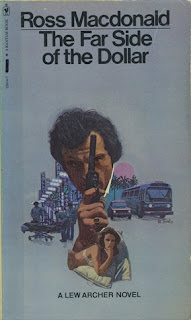
Like all of MacDonald's work, these two novels feature murders caused by ruined or poisonous family relationships that have their roots in the past, usually with a psychological motive. People don't often murder for money in Archer's world. In Zebra, a young woman kills because she's jealous of her father's affection for a girl he regards as a surrogate daughter. In Dollar, jealousy rooted in parentage becomes the reason for murder. MacDonald is certainly skillful at constructing mystery plots that move quickly and hang together logically. Where he runs into trouble is in showing how Archer deconstructs the puzzles he's faced with. The plots are absurdly dependent on Archer sub-contracting his investigations to contacts he has in law enforcement all over California. He picks up a phone and asks a detective to check out this or that, et voila, a few pages later he gets a gift-wrapped piece of crucial information. In a similar vein, when  Archer questions someone they frequently spill their guts to him faster than you can say "I don't think so." This makes the novels brutally efficient examples of storytelling, and yet lazy at the same time. 

MacDonald's writing has aged poorly in the usual ways: teenagers and young adults are faintly ridiculous creatures with their interest in music and surfing and not wearing fedoras; modern art (modern anything, really) is weird and pretentious; and the defining characteristic of women is how attractive or unattractive they are, with a special emphasis on the size, shape and movement of their breasts. Not surprising stuff for the era, but coupled with his other deficiencies it makes MacDonald a tough author to look back on with fondness. So what can I say? We had lousy taste in detective fiction back then. Sorry.


Tuesday, 7 December 2021

Film Review: Only the Animals (2019)

Quick, think of a film with the most devious and startling plot twists you've ever seen...Got it? Whatever you chose, it's not a patch on this one. Compared to this film, The Usual Suspects is an episode of Murder, She Wrote. This fiendishly-plotted French mystery-thriller came out in France two years ago, but has just been released this year (subtitled) on streaming services. Why did they make us wait? French filmmakers and writers have a definite affinity for twisted storytelling that confounds the viewer/reader, going back to Henri-Georges Clouzot's Les Diaboliques (1955). Sebastian Japrisot ranks as the grandmaster in this field having created classics of deception and intrigue on screen and in print, as have the novelists Frederic Dard and Boileau-Narcejac. Dominik Moll, the director of Only the Animals, has form in this Gallic genre, having directed the scary/nasty With a Friend Like Harry in 2000. He's created a classic this time out.

Now here's the hard part: doing a synopsis without spoilers. The plot is so finely crafted, so filled with small but crucial elements, that saying anything about it beyond generalities risks ruining it. The first scene takes place in the Cote d'Ivoire and follows a young man delivering a goat to an apartment building. The next scene is set on a snowy plateau in rural France where an abandoned car is found. And that's all that's safe to say. The story follows a handful of characters whose seemingly separate lives are invisibly linked in ways that will result in a murder. The delicate architecture of the plot and the economy with which it's told are breathtaking. But this film doesn't succeed just because of its engineering; it's not simply a technical exercise in misdirection and clue-finding like an Agatha Christie story in which the characters are merely pieces on a chessboard. These people are linked, and in some cases doomed, by their extreme need for different kinds of love, and the film, using only a few deft, narrative strokes, sketches in the causes of their heartache. 

Several reviews I've read have comparted its plot structure to Rashomon, which is somewhat misleading. Kurosawa's film looked at one event from the perspective of various characters, each of whom saw it differently as filtered through their memory and moral point of view. This film shows a series of events as seen by different characters. They all see exactly the same things, but they don't fully realize what they're looking at. Is the story farfetched? Yes, definitely. But that's what's required in a film of this type, it's what makes them so audaciously entertaining. And, like the best mystery films, Only the Animals saves one of it's most stunning reveals for the very last scene. 

Wednesday, 1 December 2021

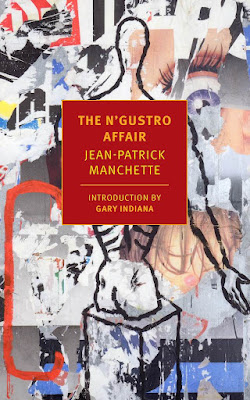
Book Review: The N'Gustro Affair (1971) by Jean-Patrick Manchette

Jean-Patrick Manchette is one of several French crime writers (Dominique Manotti, Didier Daeninckx, Pascal Garnier) who combine hard-boiled prose and characters with equally savage political and social commentary from a left-wing perspective. It's not a combination often found in Anglo-American crime writing. Julian Rathbone and early Eric Ambler come to mind, but neither were as cold-blooded and forceful as their French brethren. And in the U.S.? I can't think of any authors who fit that mold, with the possible exception of Ross Thomas.

The N'Gustro Affair is a fictionalized account of a political kidnapping and assassination that took place in France in 1965 and involved the Moroccan security services, crooked French cops, and a petty criminal. Manchette makes Henri Butron, a career thug and sociopath, the centre of his novel, which unfolds in two interlocking narratives, one told by Butron through a tape recording he makes before his (unexpected) death, the other observing two African politicians as they listen to Butron's tape. Butron tells his entire life story as one long boast about his scheming, nihilism, and cruelty. There was never a time when he was anything other than a petty monster. From a youth spent in brawls against parties of the left and right, he moves on to porn films and gun running, and finally becomes an unwitting and expendable pawn in an assassination plot. 

Butron is a truly appalling character: boastful, racist, misogynist, sadistic; I could go on and on, but suffice to say no tears are shed when he dies. Manchette has no sympathy for Butron, and doesn't try to explain his maliciousness through psychology. As in his later novels (The Prone Gunman, Fatale), Manchette sees his sociopathic central characters as natural by-products of their toxic political and cultural environment. Butron is the effluvia of a France poisoned by colonial wars and a reactionary petit bourgeois mentality. This also makes him a useful idiot/tool for bigger, more predatory fish. 

Manchette is an uncompromising chronicler of how brutal humanity can be, so much so, in fact, that at points it becomes difficult to stay with the novel. His prose, however, is always sharp and clever, and he never, ever glamorizes or humanizes his heinous characters. What mars this novel is his presentation of the African ringleaders of the conspiracy, which is filled with racist imagery. This can be partly explained by Manchette trying to portray them in as bad a light as Butron, but he does this with, at times, excessive zeal. This isn't Manchette's best novel (that would be Fatale), but it's a good introduction to a French sub-genre of crime fiction that deserves more attention.

Tuesday, 16 November 2021

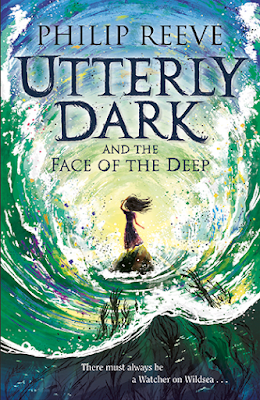
Book Review: Utterly Dark and the Face of the Deep (2021) by Philip Reeve

Let's talk about world-building. It's the keystone of sci-fi and fantasy novels, but in my reading experience it's the rare author in those fields who can do it well. Some writers over egg their pudding by cramming details about customs, languages, laws, and zoology into their writing until their "world" begins to feel like a fussy, claustrophobia-inducing, overfurnished apartment filled with things and people who apparently got their names as the result of a tragic draw of tiles from a Scrabble bag. These are the writers who probably spend their spare time building extravagant model train layouts. Frank Herbert and Iain Banks must have been enthusiastic hobbyists. On the other hand, there are authors who pay as little attention to world-building as I do to maintaining my lawn. I can recall an SF novel set on a planet that was one big ocean and yet contained only one described type of fish. One! N.K. Jemisin's The Fifth Season is very well-written but I couldn't finish it because the world-building was so threadbare. And that's the unique thing about world-building; otherwise good writers can be duds at that particular craft. 

The kings and queens of world-building would be Tolkien, Mervyn Peake, Ursula K. Le Guin, and Diane Wynne Jones. So where does that leave Philip Reeve, author of the Mortal Engines Quartet and a wide variety of other SF/F novels for the YA and JF crowd? I'd rank him as a princeling or dauphin, able to shape and populate living, breathing new worlds that fire the imagination without resorting to boxcar-sized info dumps. In Utterly Dark, the setting is an alternate reality Britain in the early Victorian period(?). Utterly Dark is also the name of a girl, a foundling who washed up on a beach in a basket on the island of Wildsea off the coast of England. She was adopted and raised by Andrewe Dark, who has the ancestral, but boring, task of watching the western seas from a tower at sundown every night. He's on the lookout for a legendary sea monster called the Gorm, who, so far, has never shown up. Andrewe drowns and Utterly takes over his job, at least until Will, Andrewe's brother, arrives from England. Soon enough, the Gorm goes from legend to kraken-ish reality, a cohort of Seaweed Men appear, as well as a sunken city and an irate Queen of the Deeps. 

Reeve's is on top of his world-building game here. Wildsea is a recognizably English world, but one seasoned with enough subtle differences to make it pleasingly new and intriguing. When the action moves on and under the ocean, things kick up a notch. The highlight is the sight of the phosphorescent souls/spirits of drowned men and women bobbing below the surface of the water like so many ethereal jellyfish. It's a brilliantly haunting image. Utterly Dark delivers in terms of imagination and adventure, but if there's problem with the novel is that it feels like an amuse bouche setting up the planned sequel(s). The undersea section is the most compelling part of the story, but, unfortunately, it doesn't take up enough of the plot. Here's hoping for an entirely sub-aqueous sequel. 

Tuesday, 9 November 2021

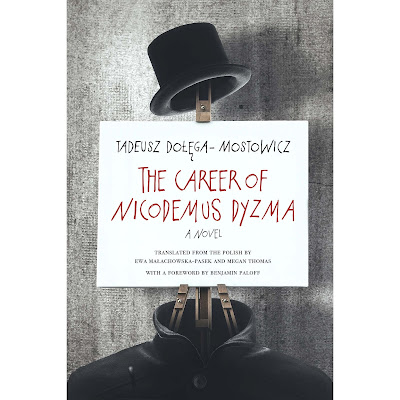
Book Review: The Career of Nicodemus Dyzma (1932) by Tadeusz Dolega-Mostowicz

This Polish satirical novel first gained fame when it became known that Polish-American novelist Jerzy Kosinski had plagiarized it for his novel Being There (1970), which later became a critically-acclaimed film starring Peter Sellers. It's only recently been translated, and it's easy to see what made it a tempting target for Kosinki: the story is wrapped up in details of Polish political and cultural life from the 1930s, but the basic concept of a ne'er-do-well making a meteoric rise from the gutter to the top thanks to a chance remark is clearly and easily transferable to other countries and times.

We meet Nicodemus, the titular rascal, just as he fails an audition to be a "taxi dancer," a job that entails being paid to dance with any and all partners at a low-rent dance hall. This is the latest in a lifetime of setbacks for Nicodemus, who's approaching forty and lives in the corner of a grotty Warsaw apartment with a prostitute and an unsympathetic landlady. Nicodemus is wandering the city when he comes into possession of an invitation for a banquet at one of Warsaw's top hotels. Since his worldly wealth consists of the evening suit which he'd hoped to use to get a dancing job, Nicodemus decides to don this disguise and go to the banquet in the hope of scarfing as much food as possible before he's thrown out. The banquet is attended by the country's political elite, and Nicodemus is just about to start gobbling some food when a man bumps into him and sends his food to the floor. In his rage at losing some nice grub, Nicodemus loudly curses the man out. The man is Terkowski, a minister in the government, who, it turns out, has many enemies and rivals, all of whom are delighted that he's been cut down a notch in public. Nicodemus harsh words are mangled and revised in the retelling, and within the space of an hour he's a hero. 

From there, Nicodemus rides a rising tide of rumor, dumb luck, and baseless supposition that casts him in the role of a financial savant who can solve Poland's economic woes. Nicodemus is avaricious enough to seize this opportunity, and cunning and ruthless enough to rise still further. The only person who sees through him immediately is an aristocratic madman, the brother of a wealthy heiress Nicodemus eventually marries. As the novel ends, Nicodemus is contemplating an offer to form Poland's next government.

The novel's satire is broad and savage, and Nicodemus's rise to the top is cleverly plotted. The author is particularly good at showing how the elites Nicodemus moves among are eager and willing to interpret his ignorant and clueless statements as pearls of wisdom, and a lot of the humour arises from this dichotomy. Any comparisons to Donald Trump are entirely appropriate. A sub-plot about a cult of devil-worshipping women who appoint Nicodemus as their leader feels out of place, but I'll assume it would have had some meaning for the novel's original audience. It's clear Kosinski stole this novel's plot, but I'd guess Dolega-Mostowicz was inspired by the story of Wilhelm Voigt. In 1906 Voigt disguised himself as a German Army captain, commandeered a group of soldiers in the small town of Kopenick, marched to the town hall and had the town's mayor arrested on fraud charges. He then took 4,000 marks from the town coffers as "evidence" and promptly disappeared. Voigt was a career petty criminal, and the success of his scam relied on the automatic and unthinking respect Germans gave to army officers. Voigt and his ruse became famous (he made a personal appearance tour!), and his story was told in films and a play called The Captain of Kopenick. The Big Lie, it seems, works equally well in fiction and real life.

Thursday, 4 November 2021

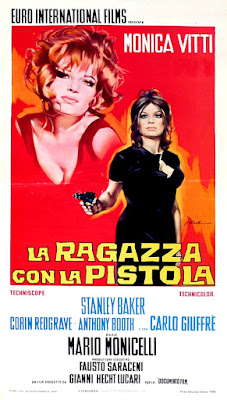
Film Review: The Girl with a Pistol (1968)


The amazing variety and quantity of good to great films produced by the Italian film industry from, say, 1955 to '75 never ceases to amaze me; what's even more startling is how many of these films are barely known or even forgotten. The big name directors like Fellini, Bertolucci, and Antonioni still get their justly deserved due, but filmmakers such as Elio Petri, Mario Monicelli, and Antonio Pietrangeli, like the other three, should be in the pantheon of directors famous enough to be known by their last names only. 

Monicelli,  the director of The Girl with a Pistol, was, and is, famous for Big Deal on Madonna Street (1958), but his greatest film, The Organizer (1963), a beautifully-crafted and entertaining story about a labour revolt in 19th-century Turin, never turns up on listicles of all-time great films. Girl is a picaresque comedy that's good, but not great, and features some of the best qualities of Italian cinema from that period. And, of course, it's almost forgotten. 

Assunta, played by Monica Vitti, is a young Sicilian woman who is accidentally abducted by her sister's suitor, Vincenzo. According to Sicilian custom, a woman taken like this must marry her kidnapper to avoid the shame of being a "dishonoured" woman. Assunta is happy to have been taken, but Vincenzo is alarmed by her sexual enthusiasm, which he feels make her a "shameless" woman. He abandons her and flees to England. Sicilian tradition dictates that Vincenzo should be killed by a male member of Assunta's family to restore Assunta's honour, but there are no men in Assunta's family. Assunta decides to follow Vincenzo to England and kill him herself.

What follows is a road movie as Assunta bounces around England searching for Vincenzo and experiences multiple culture shocks as she encounters a vastly more liberal society. After a variety of comic adventures she becomes romantically involved (sort of) with an English doctor (played by Stanley Baker) begins working as a model, becomes liberated, and finally gets a measure of revenge against Vincenzo. 

The humour in Girl is often on the broad and silly side, but Vitti's skillful, charming performance makes most of it palatable. Although the film gets some comic mileage out of poking fun at Brits (OMG men in kilts! Gay aristos!), the sharpest comic barbs are aimed at Sicily's codes of honour, modesty, and machismo that trap women and men in ridiculous and dangerous relationships. This is driven home in the film's first scene in which a rooftop full of single men dance the twist with each other while looking longingly at a shuttered window across the street behind which single women dance together to the same music. In this regard Girl is very on point for Italian cinema in its charting of the massive fault lines in Italian society. The other hallmark of the best Italian directors is their strong visual sense, and that's very much on show here. The scenes in Assunta's village are strikingly composed and include several brief fantasy sequences that are of a Fellini standard. But the English scenes! Sometimes it takes a stranger to see a country as it really is, and Monicelli shows us images of the country that UK directors of the time probably avoided. Part of the story takes place in Sheffield, and Monicelli delights in showing its blackened buildings and smoky atmosphere. And his London isn't swinging, it's dirty and filled with poky little restaurants and cafes. The film, despite being a big hit in Italy, was never released in the UK, and one wonders if it was because of how it depicted Britain and the British.

This film exists--barely, it seems--on DVD, but I saw it on YouTube, and that print has pretty minimal subtitles. Despite that drawback, it's still very entertaining and a reminder that for twenty years the Italians ruled cinema. 

Friday, 22 October 2021

Book Review: Child of All Nations (1938) by Irmgard Keun


Remember the Eloise books by Kay Thompson about a precocious ten-year-old who lives in New York's swanky Plaza Hotel with her nanny and pet pug and turtle? Now imagine Eloise plunked down with her parents in pre-war Europe and on the run from fascism, and you'll have a rough idea of what Child of All Nations delivers. Like The Passenger, which I reviewed previously on this blog, this novel is about Germans fleeing their country, one step ahead of the Gestapo.

In The Passenger, the title character never manages to leave Germany, while in this novel, Kully (the child of the title) and her parents have already left Germany and are hopscotching around Europe desperately trying to beg, borrow and steal enough money in order to pay for train fares, hotels, and boat passage to America. Told from Kully's point-of-view, Child of All Nations strives to capture the mood of Europe as it becomes awash with rumors and fears of war, and fills with political refugees desperately searching for a bolt hole, or at least a visa to a friendly country. 

Kully's father is a writer, spendthrift, and bon vivant who is ill-suited to life on the run. He drops his wife and child off in a series of hotels and rooms, some comfortable, others sketchy, while he hares around non-fascist Europe trying to get writing gigs, borrow from easy touches, and collect on monies owed to him. His wife is long suffering and frequently paralyzed with embarrassment when she's forced to lie or plead with hotel managers who want bills paid, now! Kully takes all the travel and hand-to-mouth living in stride, as children usually do, and finds amusement and wonder in the cavalcade of people she encounters as she crosses Europe, and then finally ends up in the U.S. The world she sees around her is often sad and desperate, and she has the intelligence to recognize this, but her innocence and childish joie de vivre keeps her mostly happy. It's Kully's sunniness and curiosity that throws the agonies of pre-war Europe into stark relief.

Irmgard Keun lived this story as an adult, fleeing Germany in the late '30s with her partner, Joseph Roth, a Jewish German journalist and author. Both were banned authors in Germany. Roth died in Paris in 1939 from acute alcoholism, while Keun hid out in Belgium, changed her name and then spent the rest of the war in Germany. Her novel The Artificial Silk Girl  (1931) is set in the last days of Weimar Germany, and in Ferdinand, the Man with a Kind Heart (1950) she paints a gently comic picture of Germany in the immediate aftermath of the war. Both are excellent and, fortunately, still in print.